Chapter 3: EXHAUSTIVE AND APPROXIMATE SOLUTIONS

Some Approximation Techniques in Python: Numerical Search Methods and Their Applications

Oliver Bonham-Carter

So, What are we talking about today?

Note

  • To understand exhaustive enumeration and iterative numerical techniques for approximation
  • To study and understand how algorithms use approximations to find square and cube roots
  • Compare efficiency of different approximation methods, and some of their limitations
  • To explore primality testing using enumeration
  • Implement practical Python solutions (code)

Exhaustive Versus Approximation: Two Solution Types
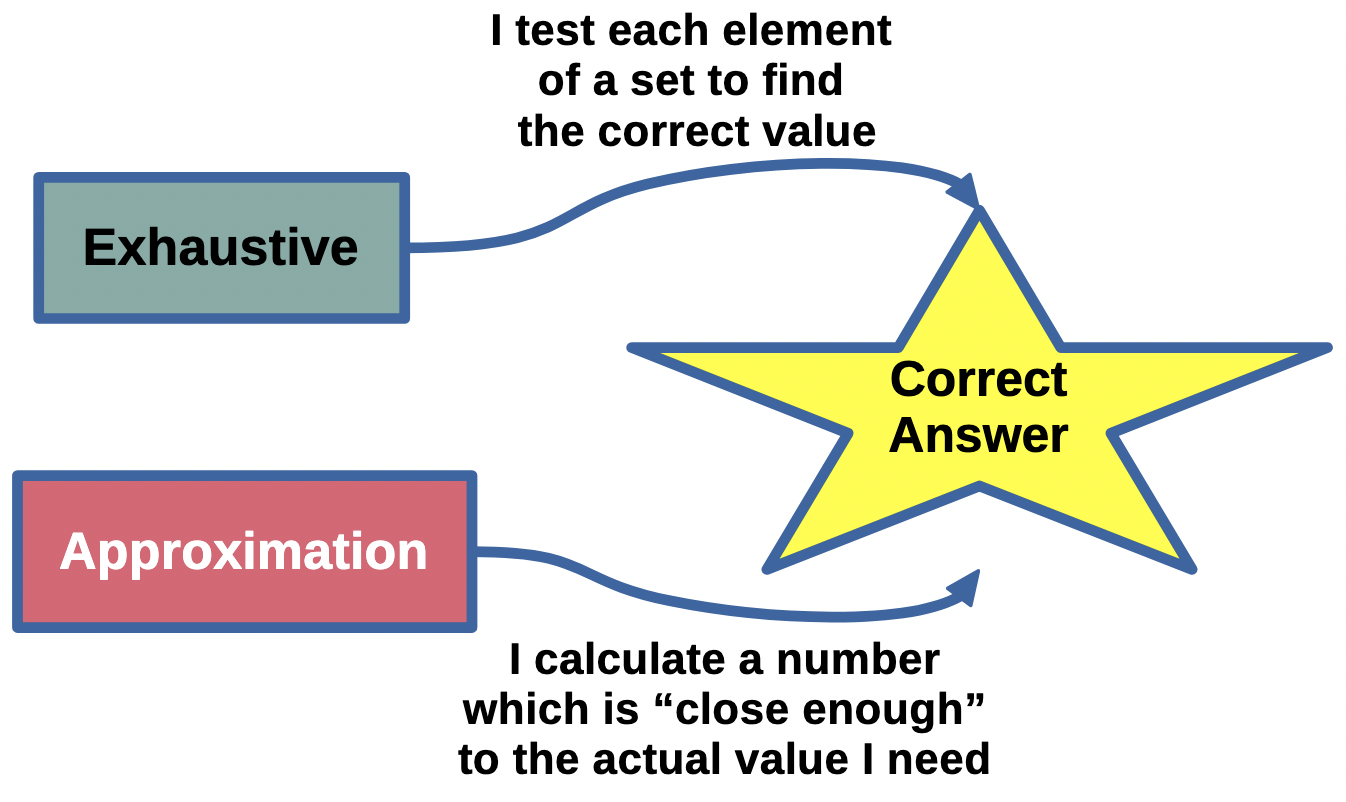
Exhaustive Method

Simple Exhaustive Square Roots

# Exhaustive square root
def simple_square_root(x):
    # find a root of a perfect root
    ans = 0
    while ans **2 < abs(x):
        ans += 1
    if ans**2 != abs(x):
        print(f"x = {x} is not perfect square root...")
    else:
        if x<0:
            ans =-ans
        print(f"Square root of {x} is {ans}.")

We count and then square the result to compare to the absolute value of the number to check.

Testing the Prototype

simple_square_root(25) # find the square root of a square.
Square root of 25 is 5.
simple_square_root(26) # not a square ...
x = 26 is not perfect square root...

simple_square_root(x)

Count, square and check

Note

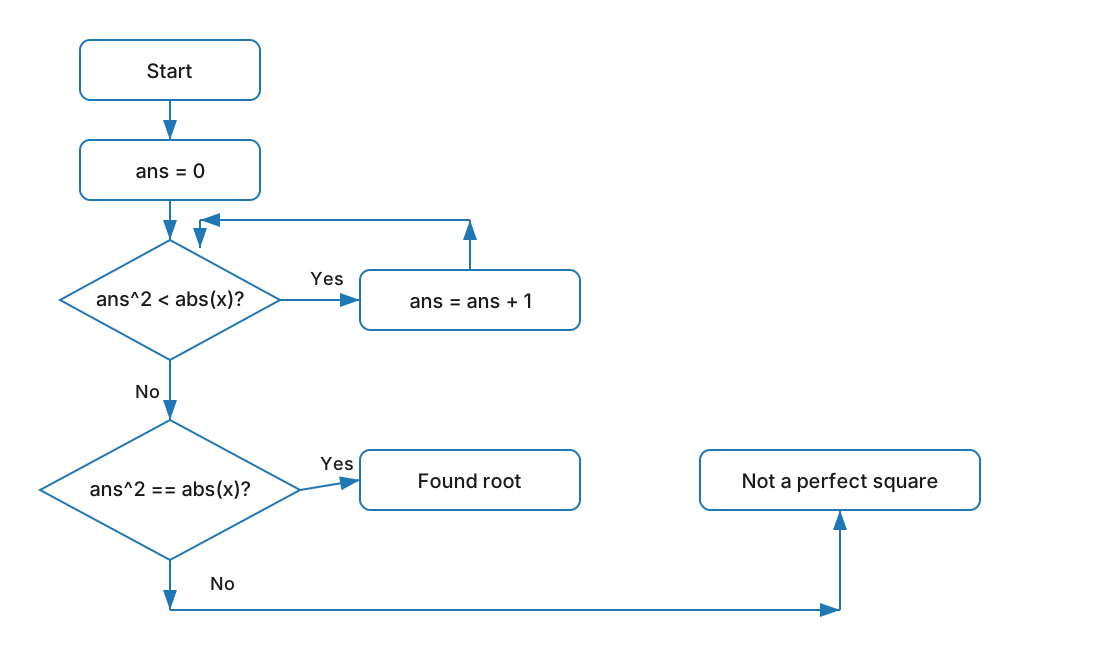
Step-by-Step Process:

  1. Start with ans = 0
  2. Check if ans² < |x|
  3. If true, increment ans by 1
  4. Repeat until ans² ≥ |x|
  5. Test if ans² exactly equals |x|

Key Logic: Exhaustive search: Tests every integer sequentially.

If ans² == |x| then the root is found. Cool!

Binary outcome: Either finds exact root or reports failure

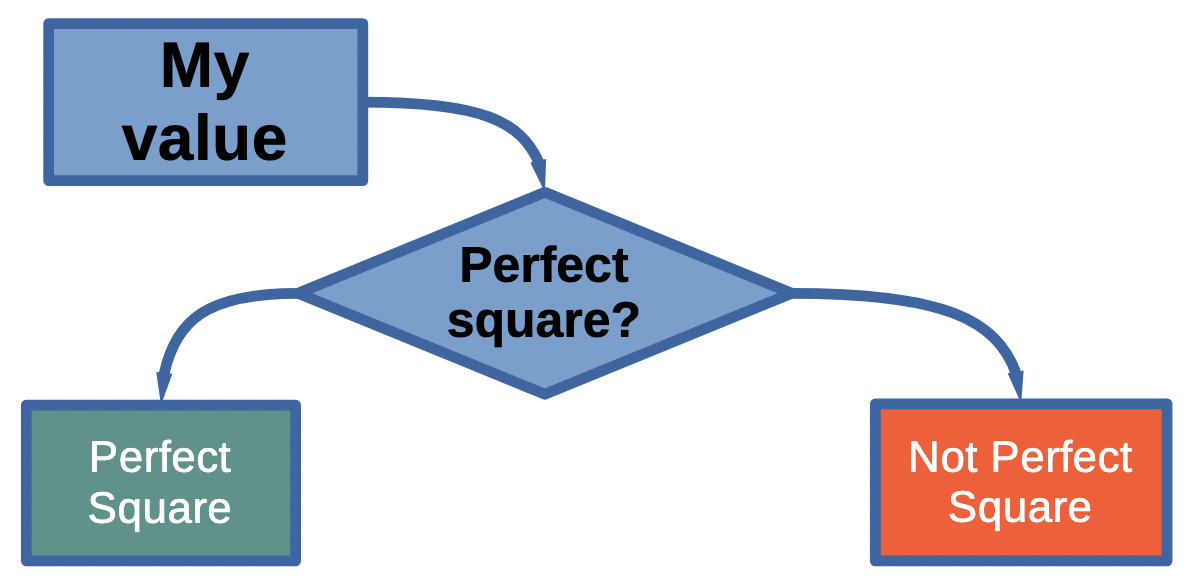
Flowchart: simple_square_root(x)

Example: For x = 25,

tests: 0^2, 1^2, 2^2, 3^2, 4^2, 5^2 = 25 ✓

Be careful!

Example: For x = 26,

tests: 0^2, 1^2, 2^2, 3^2, 4^2, 5^2, 6^2 != 26

(We just passed the correct value!!)

Simple Exhaustive Cube Roots (with same method)


# Exhaustive cube root
def simple_cube_root(x):
    # find a root of a perfect root
    ans = 0
    while ans **3 < abs(x):
        ans += 1
    if ans**3 != abs(x):
        print(f"x = {x} is not perfect cube root...")
    else:
        if x<0:
            ans =-ans
        print(f"Cube root of {x} is {ans}.")

Testing the Prototype

simple_cube_root(8) # has a cube root
Cube root of 8 is 2.


simple_cube_root(7) # does not have a cube ...
x = 7 is not perfect cube root...


simple_cube_root(x)

Count, cube and check

Note

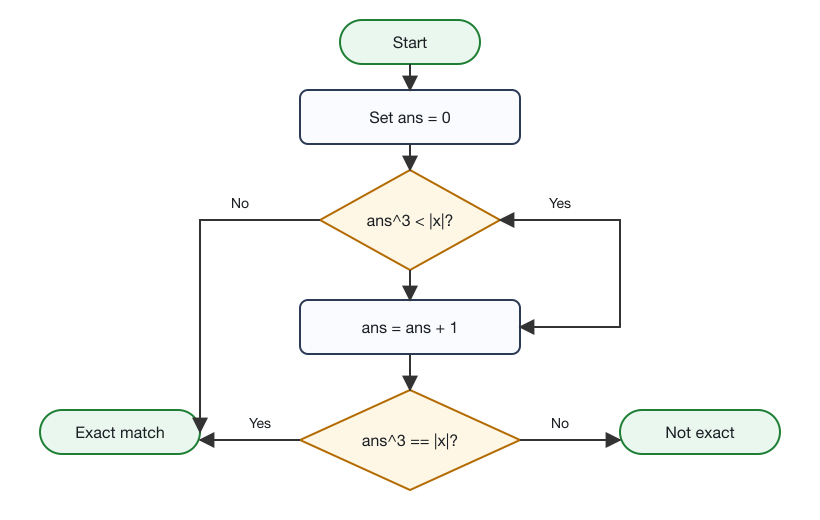
Step-by-Step Process:

(Same as before)

  1. Start with ans = 0
  2. Check if ans^3 < |x|
  3. If true, increment ans by 1
  4. Repeat until ans^3 ≥ |x|
  5. Test if ans^3 exactly equals |x|

Key Logic: Exhaustive search: Tests every integer sequentially.

If ans^3 == |x| then the root is found. Nifty!

Binary outcome: Either finds exact root or reports failure

Flowchart: simple_cube_root(x)

Testing the Flowcart

Example: For x = 8,

tests: 0^3, 1^3, 2^3 = 8 ✓

Be careful!

For x = 9, tests: 0^3, 1^3, 2^3, 3^3 != 9

(We just passed the correct value!!)

How to Generalize This?

Exhaustive \(n^{th}\) root

def simple_n_root(x, n):
    # find a root of a perfect root
    ans = 0
    while ans**n < abs(x):
        ans += 1
    if ans**n != abs(x):
        print(f"x = {x} is not perfect {n} root...")
    else:
        if x < 0:
            ans = -ans
        print(f"{n} root of {x} is {ans}.")

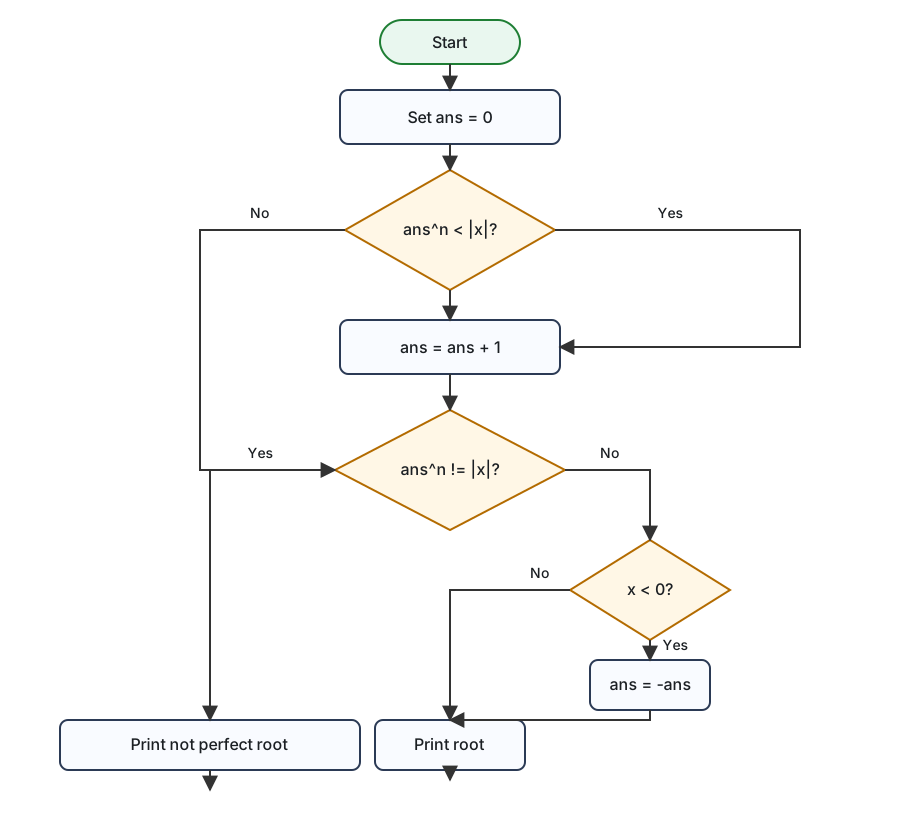
Flowchart: simple_n_root(x)

Testing the Prototype

simple_n_root(8,2) # find the square root
x = 8 is not perfect 2 root...


simple_n_root(17,2) # not a square ...
x = 17 is not perfect 2 root...


simple_n_root(9,3) # not a cube ...
x = 9 is not perfect 3 root...


Complicated Exhaustive Square Roots

Add print statements to see steps.

def exhaustive_sqrt(x, epsilon=0.01):
    """
    Find square root using exhaustive enumeration
    """
    step = epsilon
    num_guesses = 0
    ans = 0.0
    
    print(f"Finding square root of {x}")
    
    while abs(ans**2 - x) >= epsilon and ans*ans <= x:
        ans += step
        num_guesses += 1
    
    print(f"Number of guesses: {num_guesses}")
    
    if abs(ans**2 - x) >= epsilon:
        print(f"Failed to find square root of {x}")
        return None
    else:
        print(f"Square root of {x} is approximately {ans}")
        return ans

Flowchart: exhaustive_sqrt_flowchart(x)
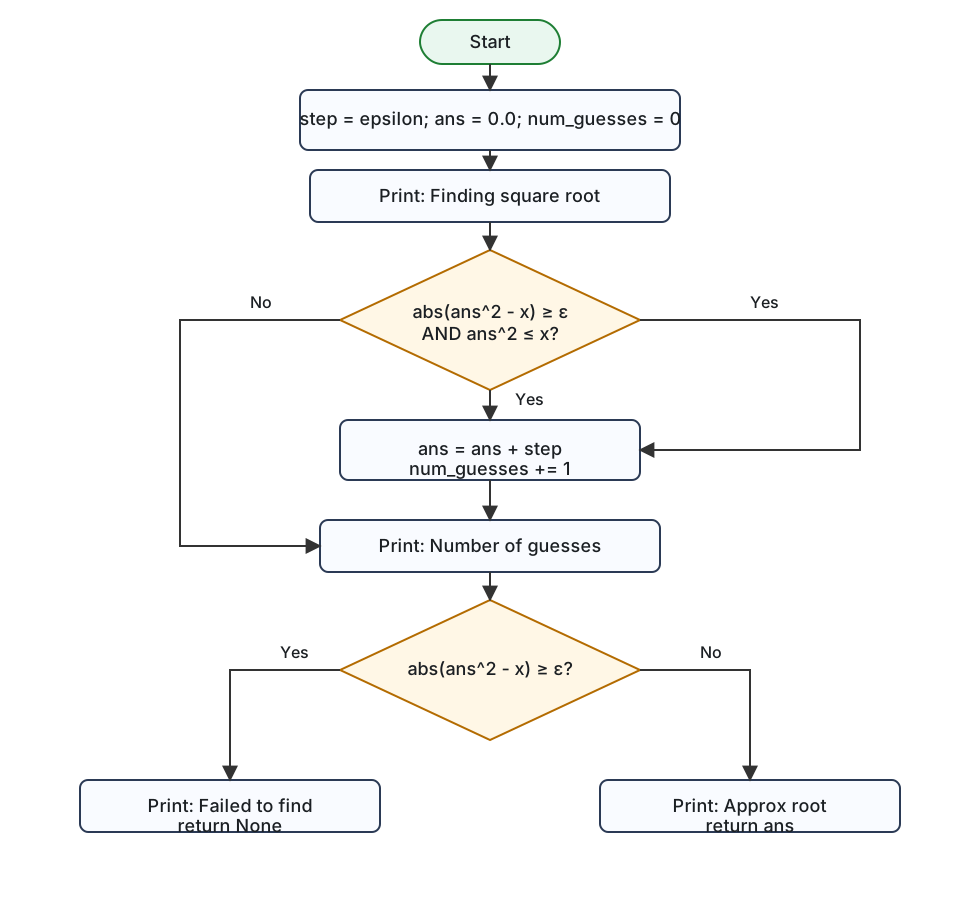
Testing the Prototype

exhaustive_sqrt(25) # find the square root of a square.
Finding square root of 25
Number of guesses: 500
Square root of 25 is approximately 4.999999999999938
4.999999999999938
exhaustive_sqrt(26) # Not a square ...
Finding square root of 26
Number of guesses: 510
Square root of 26 is approximately 5.099999999999936
5.099999999999936

How This Code Works:

Note

Algorithm Steps:

  1. Start with ans = 0.0
  2. Increment by epsilon each iteration
  3. Check if ans² is close enough to x
  4. Stop when within tolerance or exceeded target

Key Variables:

  • step: How much to increment each guess
  • num_guesses: Performance counter
  • ans: Current approximation

Loop Condition Explained:

  • abs(ans**2 - x) >= epsilon: Not accurate enough yet
  • ans*ans <= x: Haven’t exceeded target (prevents infinite loop)

Why It Works:

  • Systematically tests every possible value
  • Guaranteed to find solution if it exists
  • Simple but inefficient for large numbers

The Fundamental Limitation of Guessing and Checking

These functions use “exhaustive enumeration” over integers:

  • Perfect squares/cubes: Have integer roots (4, 9, 16, 25…)
  • Non-perfect squares/cubes: Have irrational/decimal roots

Key Insight: The algorithm design assumes the answer is an integer!
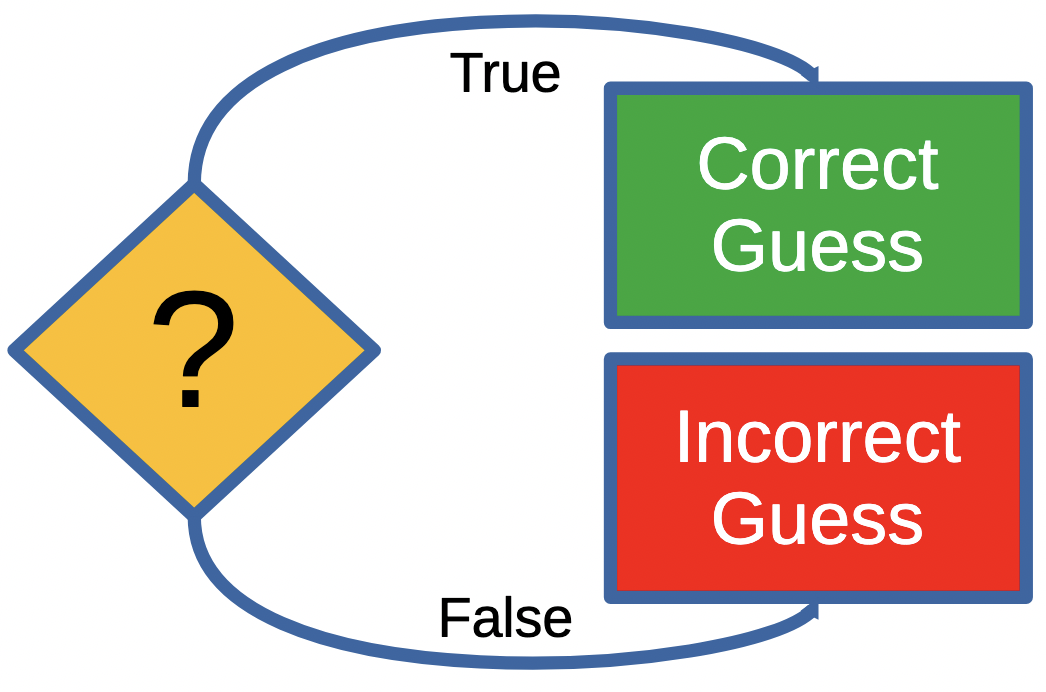
# This works:
simple_square_root (25) = 5
simple_square_root(27) = 3

# (only exact integers)
# This fails:
simple_square_root(26) = 5.099... 
simple_cube_root(26) = 2.962...

# (not integers, no results found

Exhaustive Versus Approximation: Two Solution Types

Remember this slide?

Approximation

What if I need an exact value for a root for a non-perfect integers?

Important

  • Say, my number is … 35.
  • How do I find \(\sqrt{35}\)?


Note

Note:

  • 35 is not a square …
  • 35 is not a cube …
  • 35 is not an \(n^{th}\) value of anything!
How to find exact values of any number I want?!

What We Need Instead

For approximating non-perfect roots, we need:

  1. Decimal precision (not just integers)
  2. Tolerance/epsilon (how close is “close enough?”)
  3. Different search strategies:
    • Increment by small decimals (0.01, 0.001…)
    • Newton’s method

Next: We’ll explore these approximation techniques!

So, What is Approximation?

Key Concepts:

  • Finding “good enough” solutions
  • Trading precision for efficiency
  • Iterative refinement
  • Stopping criteria (stop the approximation by setting precision)

Like, Why Approximation?

  • Exact solutions may not exist (not a perfect number)
  • Real-world applications (like how your computer does this root-finding!)

Note

Exhaustive

  • Exhaustive enumeration systematically checks all possibilities to guarantee a correct solution.
  • Best for small, finite problems,

However, Newtons Method

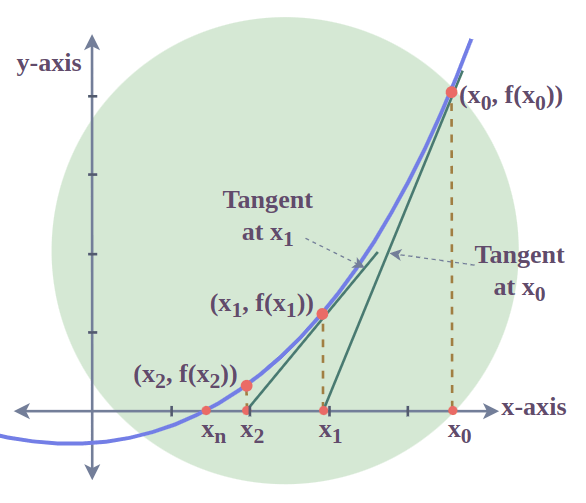
  • Newton’s method is an iterative numerical technique that rapidly approximates a solution by using tangent lines, but it is not guaranteed to find the correct answer and can fail.
  • Suited for finding accurate numerical solutions to complex equations when exhaustive checking is impossible.
Issac Newton

Whoops, here’s the right slide.

(Issac Newton)

Square Root Approximation with Newton’s Method
def newtons_sqrt(n:float, guess:float = 1.0) -> float:
    while abs(n - guess*guess) > .0001:
        print(f"n = {n}, guess = {guess}")
        print(f"   abs(n - guess*guess) = {abs(n - guess*guess)}")
        guess = guess - (guess*guess - n)/(2*guess)
        print(f"   guess = guess - (guess*guess - n)/(2*guess) = {guess}\n")

    return guess

Test using debug print statements …

my_num = 25
result = newtons_sqrt(my_num)
print(f"Verification:\n {result}^2 = ")
print(f"{result**2} is {result**2 == result**2}")
n = 25, guess = 1.0
   abs(n - guess*guess) = 24.0
   guess = guess - (guess*guess - n)/(2*guess) = 13.0

n = 25, guess = 13.0
   abs(n - guess*guess) = 144.0
   guess = guess - (guess*guess - n)/(2*guess) = 7.461538461538462

n = 25, guess = 7.461538461538462
   abs(n - guess*guess) = 30.674556213017752
   guess = guess - (guess*guess - n)/(2*guess) = 5.406026962727994

n = 25, guess = 5.406026962727994
   abs(n - guess*guess) = 4.22512752174206
   guess = guess - (guess*guess - n)/(2*guess) = 5.015247601944898

n = 25, guess = 5.015247601944898
   abs(n - guess*guess) = 0.15270850881405096
   guess = guess - (guess*guess - n)/(2*guess) = 5.000023178253949

n = 25, guess = 5.000023178253949
   abs(n - guess*guess) = 0.00023178307672111487
   guess = guess - (guess*guess - n)/(2*guess) = 5.000000000053723

Verification:
 5.000000000053723^2 = 
25.00000000053723 is True

So, how does this thing work?

  • Each approximation of \(x\) is from Equation: \(x_{n+1} = x_{n} - \frac{f(x_{n})}{f'(x_{n})}\)
    • We approach the actual value with each iteration
  • The \(\frac{f(x_{n})}{f'(x_{n})}\) term allows for us to get closer to the actual number with each approximation.
    • \(x_{0}\) to \(x_{1}\) to \(x_{2}\) to, …, to \(x_{n}\)

Cube Roots

def newtons_cube_root(n:float, guess:float = 1.0) -> float:
    while abs(n - guess*guess*guess) > .0001:
        print(f"n = {n}, guess = {guess}")
        print(f"   abs(n - guess^3) = {abs(n - guess*guess*guess)}")
        guess = guess - (guess*guess*guess - n)/(3*(guess*guess))
        print(f"   guess = guess - (guess*guess*guess - n)/(3*(guess*guess)) = {guess}\n")
    return guess
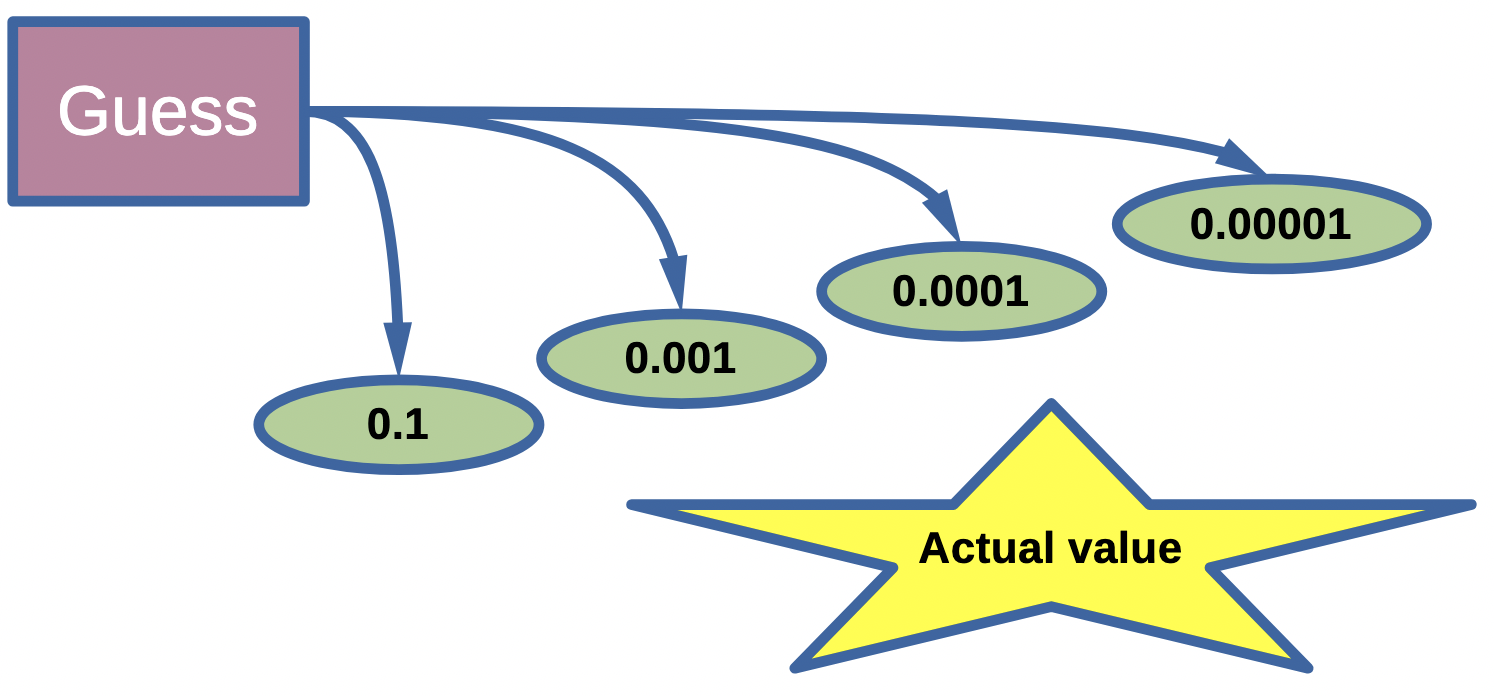
Note

We are getting increasingly closer the actual value. which is determined by the tolerance level (and hence the number of iterations) as specified here by the algorithm’s parameters.

Testing the Prototype

newtons_cube_root(8)
n = 8, guess = 1.0
   abs(n - guess^3) = 7.0
   guess = guess - (guess*guess*guess - n)/(3*(guess*guess)) = 3.3333333333333335

n = 8, guess = 3.3333333333333335
   abs(n - guess^3) = 29.037037037037045
   guess = guess - (guess*guess*guess - n)/(3*(guess*guess)) = 2.462222222222222

n = 8, guess = 2.462222222222222
   abs(n - guess^3) = 6.92731645541838
   guess = guess - (guess*guess*guess - n)/(3*(guess*guess)) = 2.081341247671579

n = 8, guess = 2.081341247671579
   abs(n - guess^3) = 1.0163315496105625
   guess = guess - (guess*guess*guess - n)/(3*(guess*guess)) = 2.003137499141287

n = 8, guess = 2.003137499141287
   abs(n - guess^3) = 0.03770908398584538
   guess = guess - (guess*guess*guess - n)/(3*(guess*guess)) = 2.000004911675504
2.000004911675504

Testing the Prototype

newtons_cube_root(27)
n = 27, guess = 1.0
   abs(n - guess^3) = 26.0
   guess = guess - (guess*guess*guess - n)/(3*(guess*guess)) = 9.666666666666666

n = 27, guess = 9.666666666666666
   abs(n - guess^3) = 876.2962962962961
   guess = guess - (guess*guess*guess - n)/(3*(guess*guess)) = 6.540758356453956

n = 27, guess = 6.540758356453956
   abs(n - guess^3) = 252.82358364070478
   guess = guess - (guess*guess*guess - n)/(3*(guess*guess)) = 4.570876778578707

n = 27, guess = 4.570876778578707
   abs(n - guess^3) = 68.49893783892396
   guess = guess - (guess*guess*guess - n)/(3*(guess*guess)) = 3.4780192333867963

n = 27, guess = 3.4780192333867963
   abs(n - guess^3) = 15.07226932492673
   guess = guess - (guess*guess*guess - n)/(3*(guess*guess)) = 3.0626891086275365

n = 27, guess = 3.0626891086275365
   abs(n - guess^3) = 1.7282216154620045
   guess = guess - (guess*guess*guess - n)/(3*(guess*guess)) = 3.001274406506175

n = 27, guess = 3.001274406506175
   abs(n - guess^3) = 0.03442359474399126
   guess = guess - (guess*guess*guess - n)/(3*(guess*guess)) = 3.0000005410641766
3.0000005410641766

Testing the Prototype

newtons_cube_root(31)
n = 31, guess = 1.0
   abs(n - guess^3) = 30.0
   guess = guess - (guess*guess*guess - n)/(3*(guess*guess)) = 11.0

n = 31, guess = 11.0
   abs(n - guess^3) = 1300.0
   guess = guess - (guess*guess*guess - n)/(3*(guess*guess)) = 7.418732782369146

n = 31, guess = 7.418732782369146
   abs(n - guess^3) = 377.30921842166106
   guess = guess - (guess*guess*guess - n)/(3*(guess*guess)) = 5.133572303084083

n = 31, guess = 5.133572303084083
   abs(n - guess^3) = 104.28792927185404
   guess = guess - (guess*guess*guess - n)/(3*(guess*guess)) = 3.814485354880487

n = 31, guess = 3.814485354880487
   abs(n - guess^3) = 24.501900623588178
   guess = guess - (guess*guess*guess - n)/(3*(guess*guess)) = 3.2531703966218446

n = 31, guess = 3.2531703966218446
   abs(n - guess^3) = 3.4286849761153846
   guess = guess - (guess*guess*guess - n)/(3*(guess*guess)) = 3.1451781175927085

n = 31, guess = 3.1451781175927085
   abs(n - guess^3) = 0.11255922102655447
   guess = guess - (guess*guess*guess - n)/(3*(guess*guess)) = 3.1413852355779674

n = 31, guess = 3.1413852355779674
   abs(n - guess^3) = 0.00013568459873170013
   guess = guess - (guess*guess*guess - n)/(3*(guess*guess)) = 3.14138065239808
3.14138065239808

General Case Structure

Note

Parameters:

  • n (int): The root to find (e.g., 2 for square root, 3 for cube root)
  • value (float): The value for which to find the nth root
  • guess (float): Initial guess (default: 1.0)

Returns:

  • float: The nth root of the value

Important

Mathematical formula:

  • For finding \(y\) such that \(y^n = value\), we use Newton’s method:
  • \(y_{new} = y - \frac{f(y)}{f'(y)}\)
  • Where, \(f(y) = y^n - value\) and \(f'(y) = n * y^{n-1}\)
  • So: y_new = y - (y^n - value)/(n * y^(n-1))

General Case

def newtons_nth_root(n: int, value: float, guess: float = 1.0) -> float:
    """
    Find the nth root of a value using Newton's method.
    
    """
    if n <= 0:
        raise ValueError("n must be a positive integer")
    if value < 0 and n % 2 == 0:
        raise ValueError("Cannot find even root of negative number")
    
    tolerance = 0.0001
    
    while abs(guess**n - value) > tolerance:
        print(f"n = {n}, value = {value}, guess = {guess}")
        print(f"   abs(guess^n - value) = abs({guess}^{n} - {value}) = {abs(guess**n - value)}")
        
        # Newton's method formula: guess_new = guess - (guess^n - value)/(n * guess^(n-1))
        guess_new = guess - (guess**n - value) / (n * guess**(n-1))
        
        print(f"   guess_new = guess - (guess^n - value)/(n * guess^(n-1))")
        print(f"   guess_new = {guess} - ({guess}^{n} - {value})/({n} * {guess}^{n-1}) = {guess_new}\n")
        
        guess = guess_new
    
    return guess

Testing the Prototype (1)

print("Square root of 16 (n=2, value=16):")
result = newtons_nth_root(2, 16)
print(f"Result: {result}")
print(f"Verification: {result}^2 = {result**2}\n")
Square root of 16 (n=2, value=16):
n = 2, value = 16, guess = 1.0
   abs(guess^n - value) = abs(1.0^2 - 16) = 15.0
   guess_new = guess - (guess^n - value)/(n * guess^(n-1))
   guess_new = 1.0 - (1.0^2 - 16)/(2 * 1.0^1) = 8.5

n = 2, value = 16, guess = 8.5
   abs(guess^n - value) = abs(8.5^2 - 16) = 56.25
   guess_new = guess - (guess^n - value)/(n * guess^(n-1))
   guess_new = 8.5 - (8.5^2 - 16)/(2 * 8.5^1) = 5.1911764705882355

n = 2, value = 16, guess = 5.1911764705882355
   abs(guess^n - value) = abs(5.1911764705882355^2 - 16) = 10.94831314878893
   guess_new = guess - (guess^n - value)/(n * guess^(n-1))
   guess_new = 5.1911764705882355 - (5.1911764705882355^2 - 16)/(2 * 5.1911764705882355^1) = 4.136664722546242

n = 2, value = 16, guess = 4.136664722546242
   abs(guess^n - value) = abs(4.136664722546242^2 - 16) = 1.1119950267585779
   guess_new = guess - (guess^n - value)/(n * guess^(n-1))
   guess_new = 4.136664722546242 - (4.136664722546242^2 - 16)/(2 * 4.136664722546242^1) = 4.002257524798522

n = 2, value = 16, guess = 4.002257524798522
   abs(guess^n - value) = abs(4.002257524798522^2 - 16) = 0.018065294806394405
   guess_new = guess - (guess^n - value)/(n * guess^(n-1))
   guess_new = 4.002257524798522 - (4.002257524798522^2 - 16)/(2 * 4.002257524798522^1) = 4.000000636692939

Result: 4.000000636692939
Verification: 4.000000636692939^2 = 16.00000509354392

Testing the Prototype (2)

print("Cube root of 27 (n=3, value=27):")
result = newtons_nth_root(3, 27)
print(f"Result: {result}")
print(f"Verification: {result}^3 = {result**3}\n")
Cube root of 27 (n=3, value=27):
n = 3, value = 27, guess = 1.0
   abs(guess^n - value) = abs(1.0^3 - 27) = 26.0
   guess_new = guess - (guess^n - value)/(n * guess^(n-1))
   guess_new = 1.0 - (1.0^3 - 27)/(3 * 1.0^2) = 9.666666666666666

n = 3, value = 27, guess = 9.666666666666666
   abs(guess^n - value) = abs(9.666666666666666^3 - 27) = 876.2962962962961
   guess_new = guess - (guess^n - value)/(n * guess^(n-1))
   guess_new = 9.666666666666666 - (9.666666666666666^3 - 27)/(3 * 9.666666666666666^2) = 6.540758356453956

n = 3, value = 27, guess = 6.540758356453956
   abs(guess^n - value) = abs(6.540758356453956^3 - 27) = 252.82358364070478
   guess_new = guess - (guess^n - value)/(n * guess^(n-1))
   guess_new = 6.540758356453956 - (6.540758356453956^3 - 27)/(3 * 6.540758356453956^2) = 4.570876778578707

n = 3, value = 27, guess = 4.570876778578707
   abs(guess^n - value) = abs(4.570876778578707^3 - 27) = 68.49893783892396
   guess_new = guess - (guess^n - value)/(n * guess^(n-1))
   guess_new = 4.570876778578707 - (4.570876778578707^3 - 27)/(3 * 4.570876778578707^2) = 3.4780192333867963

n = 3, value = 27, guess = 3.4780192333867963
   abs(guess^n - value) = abs(3.4780192333867963^3 - 27) = 15.07226932492673
   guess_new = guess - (guess^n - value)/(n * guess^(n-1))
   guess_new = 3.4780192333867963 - (3.4780192333867963^3 - 27)/(3 * 3.4780192333867963^2) = 3.0626891086275365

n = 3, value = 27, guess = 3.0626891086275365
   abs(guess^n - value) = abs(3.0626891086275365^3 - 27) = 1.728221615462001
   guess_new = guess - (guess^n - value)/(n * guess^(n-1))
   guess_new = 3.0626891086275365 - (3.0626891086275365^3 - 27)/(3 * 3.0626891086275365^2) = 3.0012744065061754

n = 3, value = 27, guess = 3.0012744065061754
   abs(guess^n - value) = abs(3.0012744065061754^3 - 27) = 0.03442359474400192
   guess_new = guess - (guess^n - value)/(n * guess^(n-1))
   guess_new = 3.0012744065061754 - (3.0012744065061754^3 - 27)/(3 * 3.0012744065061754^2) = 3.0000005410641766

Result: 3.0000005410641766
Verification: 3.0000005410641766^3 = 27.000014608735402

Testing the Prototype (3)

print("Fourth root of 81 (n=4, value=81):")
result = newtons_nth_root(4, 81)
print(f"Result: {result}")
print(f"Verification: {result}^4 = {result**4}\n")
Fourth root of 81 (n=4, value=81):
n = 4, value = 81, guess = 1.0
   abs(guess^n - value) = abs(1.0^4 - 81) = 80.0
   guess_new = guess - (guess^n - value)/(n * guess^(n-1))
   guess_new = 1.0 - (1.0^4 - 81)/(4 * 1.0^3) = 21.0

n = 4, value = 81, guess = 21.0
   abs(guess^n - value) = abs(21.0^4 - 81) = 194400.0
   guess_new = guess - (guess^n - value)/(n * guess^(n-1))
   guess_new = 21.0 - (21.0^4 - 81)/(4 * 21.0^3) = 15.752186588921283

n = 4, value = 81, guess = 15.752186588921283
   abs(guess^n - value) = abs(15.752186588921283^4 - 81) = 61488.18289808421
   guess_new = guess - (guess^n - value)/(n * guess^(n-1))
   guess_new = 15.752186588921283 - (15.752186588921283^4 - 81)/(4 * 15.752186588921283^3) = 11.81932080918686

n = 4, value = 81, guess = 11.81932080918686
   abs(guess^n - value) = abs(11.81932080918686^4 - 81) = 19434.068636062897
   guess_new = guess - (guess^n - value)/(n * guess^(n-1))
   guess_new = 11.81932080918686 - (11.81932080918686^4 - 81)/(4 * 11.81932080918686^3) = 8.876755039613878

n = 4, value = 81, guess = 8.876755039613878
   abs(guess^n - value) = abs(8.876755039613878^4 - 81) = 6127.932543617901
   guess_new = guess - (guess^n - value)/(n * guess^(n-1))
   guess_new = 8.876755039613878 - (8.876755039613878^4 - 81)/(4 * 8.876755039613878^3) = 6.686517196520891

n = 4, value = 81, guess = 6.686517196520891
   abs(guess^n - value) = abs(6.686517196520891^4 - 81) = 1917.9404828939596
   guess_new = guess - (guess^n - value)/(n * guess^(n-1))
   guess_new = 6.686517196520891 - (6.686517196520891^4 - 81)/(4 * 6.686517196520891^3) = 5.082624768192105

n = 4, value = 81, guess = 5.082624768192105
   abs(guess^n - value) = abs(5.082624768192105^4 - 81) = 586.3477398915912
   guess_new = guess - (guess^n - value)/(n * guess^(n-1))
   guess_new = 5.082624768192105 - (5.082624768192105^4 - 81)/(4 * 5.082624768192105^3) = 3.966195743486564

n = 4, value = 81, guess = 3.966195743486564
   abs(guess^n - value) = abs(3.966195743486564^4 - 81) = 166.45519543819964
   guess_new = guess - (guess^n - value)/(n * guess^(n-1))
   guess_new = 3.966195743486564 - (3.966195743486564^4 - 81)/(4 * 3.966195743486564^3) = 3.2992124877307853

n = 4, value = 81, guess = 3.2992124877307853
   abs(guess^n - value) = abs(3.2992124877307853^4 - 81) = 37.478937202150505
   guess_new = guess - (guess^n - value)/(n * guess^(n-1))
   guess_new = 3.2992124877307853 - (3.2992124877307853^4 - 81)/(4 * 3.2992124877307853^3) = 3.0382990701981023

n = 4, value = 81, guess = 3.0382990701981023
   abs(guess^n - value) = abs(3.0382990701981023^4 - 81) = 4.216184080510672
   guess_new = guess - (guess^n - value)/(n * guess^(n-1))
   guess_new = 3.0382990701981023 - (3.0382990701981023^4 - 81)/(4 * 3.0382990701981023^3) = 3.000718098021805

n = 4, value = 81, guess = 3.000718098021805
   abs(guess^n - value) = abs(3.000718098021805^4 - 81) = 0.07758243669628939
   guess_new = guess - (guess^n - value)/(n * guess^(n-1))
   guess_new = 3.000718098021805 - (3.000718098021805^4 - 81)/(4 * 3.000718098021805^3) = 3.000000257729561

Result: 3.000000257729561
Verification: 3.000000257729561^4 = 81.00002783479616

Testing the Prototype ((4)

print("4. Square root of 10 (n=2, value=10):")
result = newtons_nth_root(2, 10)
print(f"Result: {result}")
print(f"Verification: {result}^2 = {result**2}\n")
4. Square root of 10 (n=2, value=10):
n = 2, value = 10, guess = 1.0
   abs(guess^n - value) = abs(1.0^2 - 10) = 9.0
   guess_new = guess - (guess^n - value)/(n * guess^(n-1))
   guess_new = 1.0 - (1.0^2 - 10)/(2 * 1.0^1) = 5.5

n = 2, value = 10, guess = 5.5
   abs(guess^n - value) = abs(5.5^2 - 10) = 20.25
   guess_new = guess - (guess^n - value)/(n * guess^(n-1))
   guess_new = 5.5 - (5.5^2 - 10)/(2 * 5.5^1) = 3.659090909090909

n = 2, value = 10, guess = 3.659090909090909
   abs(guess^n - value) = abs(3.659090909090909^2 - 10) = 3.3889462809917354
   guess_new = guess - (guess^n - value)/(n * guess^(n-1))
   guess_new = 3.659090909090909 - (3.659090909090909^2 - 10)/(2 * 3.659090909090909^1) = 3.196005081874647

n = 2, value = 10, guess = 3.196005081874647
   abs(guess^n - value) = abs(3.196005081874647^2 - 10) = 0.21444848336856914
   guess_new = guess - (guess^n - value)/(n * guess^(n-1))
   guess_new = 3.196005081874647 - (3.196005081874647^2 - 10)/(2 * 3.196005081874647^1) = 3.1624556228038903

n = 2, value = 10, guess = 3.1624556228038903
   abs(guess^n - value) = abs(3.1624556228038903^2 - 10) = 0.0011255662039406644
   guess_new = guess - (guess^n - value)/(n * guess^(n-1))
   guess_new = 3.1624556228038903 - (3.1624556228038903^2 - 10)/(2 * 3.1624556228038903^1) = 3.162277665175675

Result: 3.162277665175675
Verification: 3.162277665175675^2 = 10.000000031668918

Challenge!

Can you modify the newtons_cube_root() algorithm to find the forth root newtons_4_root()


Hint: Use the general case to create the code.

Challenge Set (5)

Solve each challenge with a short Python function and a quick test.

Challenge 1: Perfect-Square Tester

Task: Write is_perfect_square(n) that returns True if n is a perfect square and False otherwise.

Constraints: Use exhaustive enumeration (counting up).
Challenge 2: Epsilon Square Root

Task: Write approx_sqrt(x, epsilon=0.001) using exhaustive enumeration with a step size of epsilon.

Return the approximation and the number of guesses.
Challenge 3: Count Newton Steps

Task: Write newtons_sqrt_steps(x, guess=1.0, tol=1e-4) that returns 1) the approximation and 2) how many iterations it took.

Challenge 4: Integer Cube Root (No Decimals)

Task: Write int_cube_root(n) that returns the integer cube root if it exists, otherwise returns None.

Use exhaustive enumeration only.

Challenge 5: Compare Methods

Task: Write compare_methods(x) that prints two lines:

  • The values of exhaustive approximation (epsilon = 0.001) and the values of the guesses for each iteration of “simple_square_root(x)”
  • Then print the values of guesses for each iteration “newtons_sqrt()”

Which algorithm do you suppose is better? Why?

 

Solutions

Below are sample solutions with short explanations.

Solution 1: Perfect-Square Tester

Idea: Count up until k^2 is at least n, then compare.

def is_perfect_square(n: int) -> bool:
    if n < 0:
        return False
    k = 0
    while k * k < n:
        k += 1
    return k * k == n


print(is_perfect_square(25))
print(is_perfect_square(26))
True
False

Solution 2: Epsilon Square Root

Idea: Step by epsilon and stop when the square is close enough.

def approx_sqrt(x: float, epsilon: float = 0.001):
    if x < 0:
        return None, 0
    step = epsilon
    ans = 0.0
    guesses = 0
    while abs(ans * ans - x) >= epsilon and ans * ans <= x:
        ans += step
        guesses += 1
    if abs(ans * ans - x) >= epsilon:
        return None, guesses
    return ans, guesses


print(approx_sqrt(25))
print(approx_sqrt(26))
(5.000000000000004, 5000)
(5.0990000000000375, 5099)

Solution 3: Count Newton Steps

Idea: Track iterations while updating with Newton’s method.

def newtons_sqrt_steps(x: float, guess: float = 1.0, tol: float = 1e-4):
    if x < 0:
        return None, 0
    steps = 0
    while abs(x - guess * guess) > tol:
        guess = guess - (guess * guess - x) / (2 * guess)
        steps += 1
    return guess, steps


print(newtons_sqrt_steps(25))
print(newtons_sqrt_steps(26))
(5.000000000053723, 6)
(5.099019513684701, 6)

Solution 4: Integer Cube Root

Idea: Count up until k^3 reaches or passes |n|, then check.

def int_cube_root(n: int):
    target = abs(n)
    k = 0
    while k ** 3 < target:
        k += 1
    if k ** 3 != target:
        return None
    return k if n >= 0 else -k


print(int_cube_root(27))
print(int_cube_root(28))
print(int_cube_root(-8))
3
None
-2

Solution 5: Compare Methods

Idea: One way to determine “better-ness”; Try running both algorithms and report results with effort.

def compare_methods(x: float, epsilon: float = 0.001, tol: float = 1e-4):
    approx, guesses = approx_sqrt(x, epsilon)
    newton, steps = newtons_sqrt_steps(x, tol=tol)
    print(f"Exhaustive: approx={approx}, guesses={guesses}")
    print(f"Newton:     approx={newton}, steps={steps}")


compare_methods(26)
Exhaustive: approx=5.0990000000000375, guesses=5099
Newton:     approx=5.099019513684701, steps=6