ALGORITHM COMPLEXITIES
Understanding How Things Scale in Everyday Life
Welcome to Algorithm Complexities! 🚀
On For Today 🎯
Tip
Let’s explore Complexity Levels that describe how things scale in real life!!
Topics covered in today’s discussion:
- 🎪 O(1) - The Magic Trick Level
- 🔍 O(log n) - The Smart Detective Level
- 🚶 O(n) - The One-by-One Level
- 🐌 O(n²) - The Handshake Problem Level
- 💥 O(2ⁿ) - The Explosion Level

Complexity is All About How Things Scale 📈
Note
Complexity = How much more work do you need when you have more stuff to deal with?
Real-Life Examples:
- 🍕 Making dinner for friends: 2 friends vs 20 friends - how much more work?
- 📚 Finding a book: In a small pile vs a huge library - how much longer?
- 🎁 Gift wrapping: 5 gifts vs 50 gifts - how much more time?
- 👋 Meeting everyone at a party: 10 people vs 100 people - how many more handshakes?
The Big Question 💭
(One that every programmer will wonder!)
When you double the amount of “stuff,” what happens to the amount of work?
- Does it stay the same?
- Double too?
- Get way worse?
- Or explode completely?
That’s what complexity tells us! 🎯
Let’s explore each complexity level! 🚀
O(1) - The Magic Trick Level ⚡
“No Matter How Much, It Takes the Same Time!” 🎪
O(1) means: Whether you have 1 thing or 1 million things, the task takes exactly the same amount of time!
Everyday O(1) Examples:
🔑 Using a key to open your door - Same one turn always!
💡 Turning on a light switch - Same flip always!
📱 Checking the time on your phone - Always instant!
🏧 Using your debit card - Same swipe time always!
Why O(1) is Amazing ⚡
The Holy Grail of Algorithms! 🏆
✨ It’s like magic - the amount of work never changes
🎯 Perfect performance - always fast, always reliable
🚀 Every programmer dreams of O(1) solutions!
Real-World O(1) Examples:
- 🪑 Sitting down in a chair
- 📱 Looking up a contact by name
- 💳 Checking account balance
- 🎵 Skipping to specific song
- 📦 Grabbing the top item from a stack
O(1) Complexity Visualization 📊
O(log n) - The Smart Detective Level 🕵️
“Cut the Problem in Half, Over and Over!” 🔍
O(log n) means: Each step eliminates half of what’s left to search. Super efficient even with huge amounts!
Everyday O(log n) Examples:
🎯 Guessing a number 1-1000 - Cut problem in half each time, found in ~10 questions max!
📖 Finding word in dictionary - Open to middle, go left or right, found in seconds!
🎪 20 Questions game - Each question eliminates half the possibilities
🔍 Phone contact search - Type “J” → cuts to J names, type “Jo” → even fewer options
🗂️ Looking for a file in a sorted filing cabinet - Open to middle, go left or right, found in seconds!
Why O(log n) is Amazing 🏆
Incredible Scaling Performance! 📊
Amazing scaling: * 1,000 items → ~10 steps * 1,000,000 items → ~20 steps
* 1,000,000,000 items → ~30 steps
🧠 Smart strategy beats brute force
Used everywhere:
- 🔍 Google searches
- 🗺️ GPS route finding
- 📱 Phone contact search
But What’s the Catch?

The catch: You need things organized first! 📋
(This might take some time, but once it’s done, searching is lightning fast!)
O(log n) Complexity Visualization 📊
O(n) - The One-by-One Level 🚶
“Check Every Single Thing, One by One” 👀
O(n) means: Double the stuff = Double the work. Fair and predictable!
Everyday O(n) Examples:
📚 Reading every page in a book - 100 pages = 100 page flips, 200 pages = 200 page flips
🛒 Counting items in shopping cart - Must touch each item once, 10 items = 10 counts
🎵 Listening to playlist - 50 songs = 50× the time
📝 Grading test stack - 30 tests = 30× the work
The good news: O(n) is often the best you can do for many tasks
- Easy to determine the time necessary for running
ntasks. You can determine smallest run-time with accuracy!
Why O(n) is Pretty Good ✅
Predictable and Fair! 📈
✅ Predictable and fair - work scales linearly
🎯 Working at scale - Doubling the input only doubles the work, not more!
📈 Reasonable for most tasks: O(n) is often the “best possible” complexity, not just a “good” one. Even though it’s not constant time, it’s: Predictable, Scalable, and Optimal for many real-world problems
- Finding highest grade
- Adding up expenses
- Reading all text messages
When it gets slow:
Really large amounts of data - but still very manageable for normal use! 🎯
O(n) Complexity Visualization 📊
O(n²) - The Handshake Problem Level 🤝
“Everyone Must Meet Everyone Else!” 😰
O(n²) means: When you double the people, you get four times the work! This gets crazy fast.
Everyday O(n²) Examples:
🤝 Party introductions - 4 people = 6 handshakes, 8 people = 28 handshakes, 16 people = 120 handshakes!
🏆 Sports tournament - Everyone plays everyone, gets expensive fast!
👥 Group photo arrangements - Every person next to every other, gets overwhelming quickly!
📝 Comparing all student tests - Looking for identical answers, 30 students = 435 comparisons!
Why O(n²) Gets Scary 📈
Explosive Growth! 💥
📈 Explosive growth:
- 10 things → 100 operations
- 100 things → 10,000 operations
- 1,000 things → 1,000,000 operations!
⚠️ The danger zone - where apps become unusably slow
🐌 Common culprits: * Comparing every item to every other * Nested loops in programming * Poor algorithm choices
When to worry: Anything over ~1,000 items gets really slow! 🚨
O(n²) Complexity Visualization 📊
O(2ⁿ) - The Explosion Level 💥
“Every Choice Doubles Your Problems!” 🤯
O(2ⁿ) means: Add just one more thing, and you double all the work! This explodes instantly.
Everyday O(2ⁿ) Examples:
🧬 Family tree exploration - 2 parents → 4 grandparents → 8 great-grandparents → 16 great-great-grandparents
🔐 Password cracking - Each digit doubles possibilities, 10-digit PIN = 1+ billion combos!
🎁 Gift wrapping combinations - Each gift: wrapped or not, 20 gifts = 1+ million combinations!
Why O(2ⁿ) is Terrifying 💀
Grows Impossibly Fast! 🚨
💀 Grows impossibly fast:
- 10 things → 1,024 operations
- 20 things → 1,048,576 operations
- 30 things → 1,073,741,824 operations!
🚫 Usually unusable for anything but tiny problems
⏰ Real-world impact:
- Why cryptography works (good!)
- Why some problems are “impossible” (bad!)
Bottom line: Avoid at all costs unless you have < 20 items! ⚠️
O(2ⁿ) Complexity Visualization 📊
The Complexity Race Table 🏃♀️💨
Let’s see what happens when we have 1,000 things to process.
| Complexity | Name | Steps Needed | Real-World Feeling |
|---|---|---|---|
| O(1) | Magic Trick | 1 step | ⚡ Instant! |
| O(log n) | Smart Detective | ~10 steps | 🏃 Super fast! |
| O(n) | One-by-One | 1,000 steps | 🚶 Takes a moment |
| O(n²) | Handshake Problem | 1,000,000 steps | 🐌 Ugh, so slow… |
| O(2ⁿ) | Explosion | 2¹⁰⁰⁰ steps | 💀 Heat death of universe |
Complexity Analysis can Blow Your Mind! 🤯
The Big Takeaway 🎯
Small differences in complexity = HUGE differences in real-world performance!
This is why choosing the right approach matters so much in programming! 🚀
Ready for your challenge? Let’s become complexity detectives! 🕵️♂️
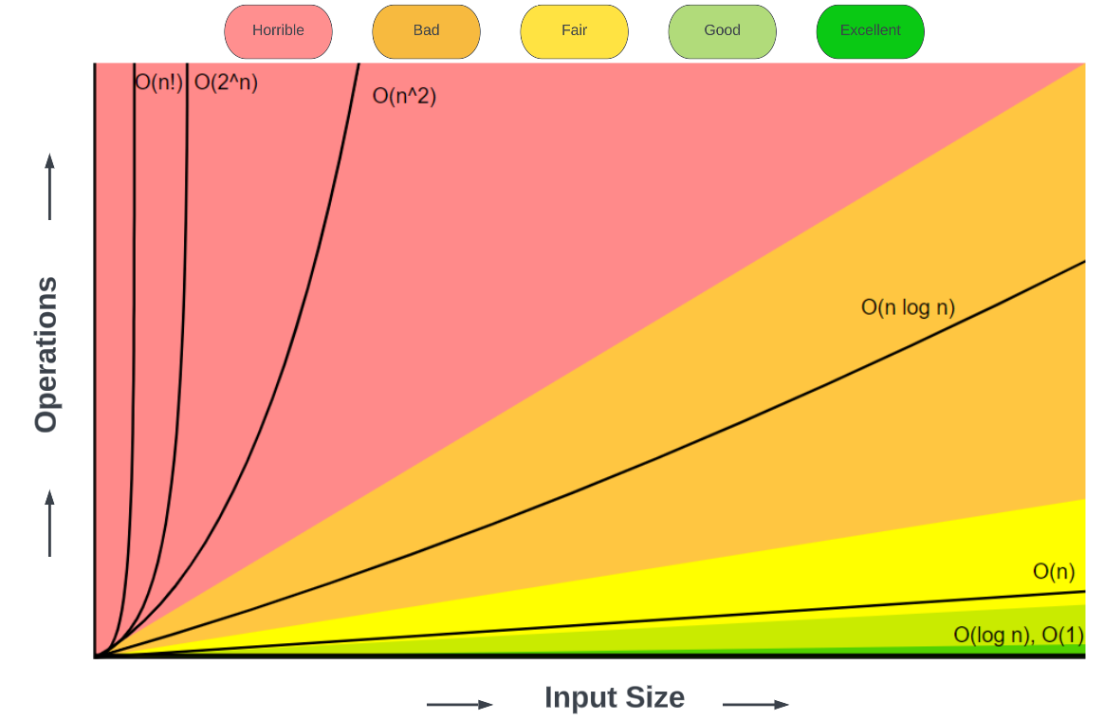
📊 Complete Complexity Comparison
Key Observations from the Complexity Comparison! 📈
- 🟢 O(1) stays perfectly flat
- 🔵 O(log n) grows very slowly
- 🟠 O(n) grows steadily
- 🔴 O(n²) accelerates quickly
- 🟣 O(2ⁿ) explodes exponentially
Challenge: Guess the Complexity Level! 🏗
| Task | Complexity | Justification |
|---|---|---|
| 🧑🍳 Cooking a meal for 4 people | ? | ? |
| 📚 Finding a word in a dictionary | ? | ? |
| 🧬 Exploring family tree generations | ? | ? |
| 🧑🤝🧑 Introducing everyone at a party | ? | ? |
| 🔍 Searching for a name in your phone contacts | ? | ? |
| 🎁 Figuring out gift wrapping combinations for 10 gifts | ? | ? |
| 📖 Reading every page in a book | ? | ? |
Important
The below tasks are all over the place! Define the tasks according to complexity: easiest (O(1)) to hardest (O(2ⁿ)). Work in groups to justify your choices! Be prepared to share with the class! 🚀
Detection of the Daily Complexity 🕵️♂️
Now You’re Ready for the Challenges! 🎯
You’ve learned the 5 complexity levels. Time to become complexity detectives and find examples from your own life! Work in groups to come up with a real world task (that you complete!) for each complexity level. Be prepared to share your findings with the class! 🚀
Remember the Levels! 📋
The 5 Complexity Levels:
- ⚡ O(1) - Magic Trick (always same time)
- 🔍 O(log n) - Smart Detective (cut in half)
- 🚶 O(n) - One-by-One (check everything)
- 🤝 O(n²) - Handshake Problem (everyone meets)
- 💥 O(2ⁿ) - Explosion (choices double work)
Solutions: Arrange Tasks by Complexity Level 🏗
| Task | Complexity | Estimated Steps Needed |
|---|---|---|
| 🧑🍳 Cooking a meal for 4 people | O(n) | n = number of people (or portions) |
| 📚 Finding a word in a dictionary | O(log n) | n = number of words |
| 🧬 Exploring family tree generations | O(2ⁿ) | n = number of generations |
| 🧑🤝🧑 Introducing everyone at a party | O(n²) | n = number of people |
| 🔍 Searching for a name in your phone contacts | O(n) | n = number of contacts |
| 🎁 Figuring out gift wrapping combinations for 10 gifts | O(n!) | n = number of gifts |
| 📖 Reading every page in a book | O(n) | n = number of pages |
Important
Listed according by easiest (O(1)) to hardest (O(2ⁿ))
Justifications of Complexity Levels 🕵️♂️
🧑🍳 Cooking a meal for 4 people → O(n)
n = number of people (or portions) You typically scale ingredients and prep roughly linearly with servings.
📚 Finding a word in a dictionary → O(log n) (if using a sorted dictionary)
n = number of words Like binary search: you repeatedly halve the search space. If unsorted, it would degrade to O(n).
🧬 Exploring family tree generations → O(2ⁿ) (exponential)
n = number of generations Each generation roughly doubles (2 parents, 4 grandparents, etc.).
🧑🤝🧑 Introducing everyone at a party → O(n²) n = number of people If everyone is introduced to everyone else, you get pairwise interactions.
🔍 Searching for a name in your phone contacts → O(n) (typical case)
n = number of contacts Linear scan if unsorted. Could be O(log n) if perfectly sorted and searched efficiently.
🎁 Figuring out gift wrapping combinations for 10 gifts → O(n!) (factorial)
n = number of gifts If considering all possible orderings or combinations of wrapping, this grows extremely fast.
📖 Reading every page in a book → O(n)
n = number of pages You process each page once.
CS 101 - Algorithm Complexities